Detail: ML Bayes Estimator
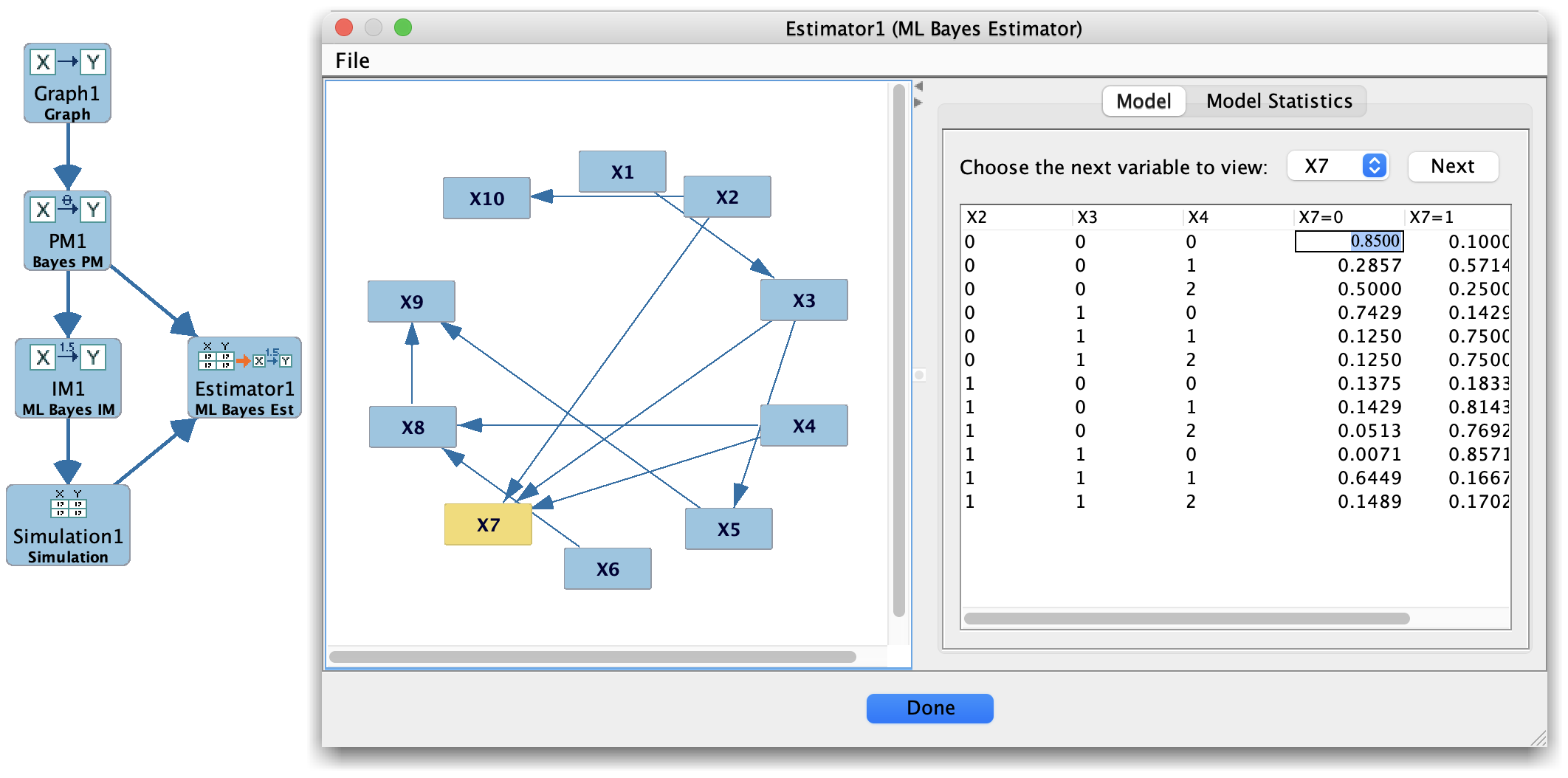
The ML Bayes Estimator fits a Bayes Parametric Model to data using maximum likelihood (or equivalently, empirical relative frequencies in the purely discrete case). It is the simplest option for estimating the conditional probability tables (CPTs) of a Bayesian network, given fully observed data.
This estimator is available whenever the Parametric Model connected to the Estimator box is a Bayes PM and a compatible dataset is selected.
Bayes (Multinomial) Estimator
Purpose
Estimate CPT entries directly from the observed data.
Provide a baseline Bayesian-network fit without prior smoothing.
Support downstream use in:
Instantiated Model (for simulation and prediction),
Compare (to compare different learned Bayes structures),
and other tools that rely on a fully specified Bayes model.
Inputs and requirements
Parametric Model: A Bayes PM specifying:
Nodes and their states.
Parent sets for each node (the graph structure).
Data:
Typically a discrete dataset whose variables match the Bayes PM nodes.
Each row is treated as an i.i.d. sample.
Rows with missing or invalid values may be discarded or treated according to the Estimator’s missing-data settings (if available in your version).
How it works (conceptually)
For each node (X) with parents (\mathrm{Pa}(X)), the ML Bayes Estimator:
Counts how many times each configuration of (\mathrm{Pa}(X)) appears.
For each such configuration, counts how many times each state of (X) occurs.
Forms relative frequencies: [ \hat{P}(X = x \mid \mathrm{Pa}(X) = \pi) = \frac{\text{count}(X = x, \mathrm{Pa}(X) = \pi)} {\text{count}(\mathrm{Pa}(X) = \pi)}. ]
No prior smoothing is applied, so zero-count events yield zero probabilities.
Output
A fitted Bayes model with:
All CPT entries filled by ML estimates.
(When available) basic fit information such as log-likelihood and possibly information criteria (e.g., BIC).
The result can be registered as an Instantiated Model for:
Simulation,
Prediction,
or comparison with other parameterizations.
Tips and common issues
If the data are sparse, ML estimates may assign zero probability to some configurations. If this is problematic (e.g., for simulation or inference), consider using the Dirichlet Estimator instead, which adds prior smoothing.
Ensure that dataset variable names and state encodings match those in the Bayes PM exactly.
If estimation fails, check for:
Rows containing states not defined in the Bayes PM.
Incompatible variable types (e.g., continuous variables in a discrete model).