Detail: Generalized SEM Estimator
The Generalized SEM Estimator fits a Generalized SEM Parametric Model, allowing for non-Gaussian outcomes (such as binary or count variables) and a variety of link functions (e.g., logistic, probit, log link). It extends the classical SEM framework to a broader family of response types.
This estimator is available when the Parametric Model connected to the Estimator box is a Generalized SEM PM.
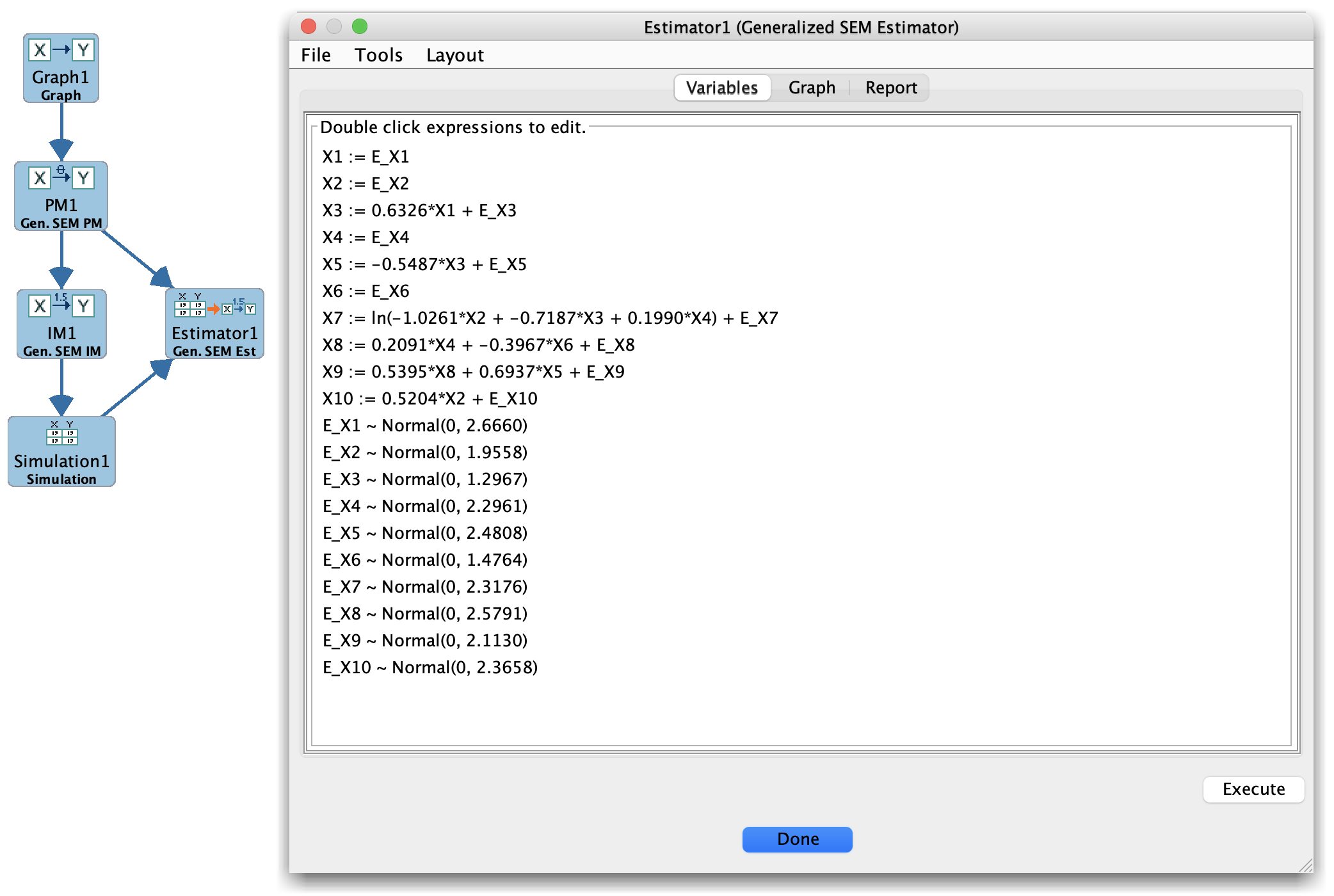
Generalized SEM Estimator
Purpose
Estimate structural relations in models where:
Some variables are binary, ordinal, or counts.
Different nodes may use different link functions and distributions.
Provide parameter estimates and fit measures appropriate for generalized linear/SEM-type models.
Inputs and requirements
Parametric Model: A Generalized SEM PM specifying:
Which variables are treated with which distribution/link (e.g., logistic for binary, Poisson for counts).
Structural relations between variables (regressions, latent variables, etc.).
Data:
Variables conforming to the specified distributions.
Sufficient variation across categories and ranges.
Estimation options (when available), such as:
Choice of link functions (if configurable).
Optimization method and convergence tolerance.
Handling of missing data.
Maximum number of iterations.
How it works (conceptually)
The estimator typically:
For each endogenous variable, sets up a generalized linear model (GLM) or related component consistent with the generalized SEM specification.
Uses iterative procedures (e.g., iteratively reweighted least squares or other gradient-based methods) to jointly estimate parameters across the system, respecting cross-equation constraints and latent structure, if present.
Computes:
Parameter estimates,
Standard errors (if available),
Overall or per-component fit statistics.
Output
Parameter estimates:
Regression coefficients on the scale of the chosen link function.
Variance components or dispersion parameters, when applicable.
Fit information, which may include:
Log-likelihood,
Information criteria (AIC, BIC),
Convergence diagnostics.
The fitted model can be stored as an Instantiated Model (Generalized SEM).
Tips and common issues
Ensure that the variable coding (e.g., 0/1 for binary) matches the distribution and link choices.
Check convergence diagnostics; generalized SEMs can be more numerically demanding than standard SEMs.
If estimation fails or yields extreme parameter values:
Inspect for separation in binary outcomes or very low counts.
Consider simplifying the model or changing link functions.
Verify that the data support the specified distributional assumptions.