Detail: Junction Tree Updater
The Junction Tree Updater is the default updater for discrete models. It performs exact Bayesian updating on an instantiated discrete model, given specified evidence (observed variable values) and manipulations (interventions).
It is available when the Updater box is connected to an Instantiated Model (IM) or Estimator that produces a discrete Bayesian model.
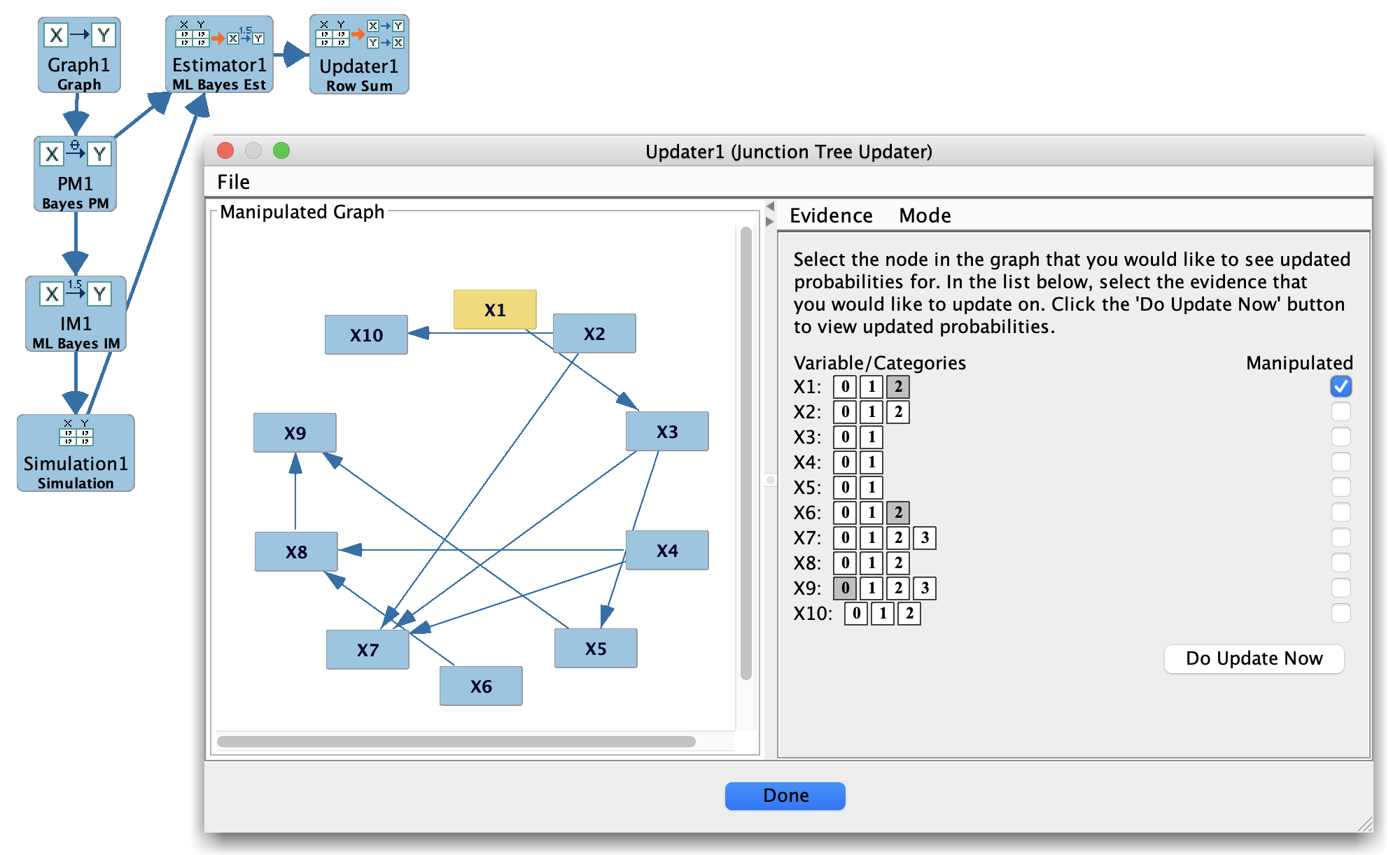
Junction Tree Updater
Purpose
Compute posterior distributions for query variables given:
Observations on some variables,
Manipulations/interventions on others.
Support “learning from data” within a fixed model:
The structure and CPTs come from the IM/Estimator,
The Updater propagates new information through the graph.
Typical uses:
Compute (P(Y \mid X = x)) or (P(Y \mid \text{do}(X = x))) in a discrete Bayes model.
Explore how different evidence or interventions change posterior beliefs.
Inputs and setup
The Updater box takes as input:
An Instantiated Model or Estimator output that is a discrete Bayes model.
The user then specifies:
Evidence: values for some variables (e.g., (X = x), (Z = z)).
Manipulations: variables to intervene on (e.g., do(X = x)), typically by marking them as manipulated and assigning a value.
These are set via the Updater’s interface (e.g., a table of variables with columns for value and manipulation).
How it works (conceptually)
Internally, the Junction Tree Updater:
Takes the discrete Bayes model and builds a junction tree / clique tree representation.
Initializes clique potentials based on the model’s CPTs.
Incorporates evidence:
Potentials inconsistent with the observed values are zeroed out.
Potentials are renormalized.
Incorporates manipulations (do-interventions) by:
Clamping manipulated variables to their specified values, and
Removing or neutralizing incoming influences, depending on the underlying implementation.
Runs message passing on the junction tree until all cliques are calibrated.
Reads off posterior marginals for variables of interest from the calibrated cliques.
Because it is junction-tree based, this updater is exact for the given model (up to numerical precision).
Output
Posterior distributions for variables given evidence and manipulations.
In the GUI this may be shown as:
Updated probabilities for each state of a chosen variable,
Updated expectations for functions of the variables (where supported).
The underlying instantiated model typically remains fixed; the updater operates “on top” of it.
Tips
Use the Junction Tree Updater whenever exact inference is feasible; it is the default discrete updater.
For large or highly connected models, exact junction-tree inference may be computationally expensive; in those cases the Approximate Updater may be preferable.
Be clear about the distinction between:
Evidence (observations: “we saw (X = x)”),
Manipulations (interventions: “we set (X = x)”).