Detail: Dirichlet Estimator
The Dirichlet Estimator fits a Bayes Parametric Model to data using a Dirichlet prior over each row of the conditional probability tables (CPTs). It is a Bayesian-smoothing alternative to plain ML estimation, reducing zero-probability problems in sparse data.
This estimator is available whenever the Parametric Model connected to the Estimator box is a Bayes PM.
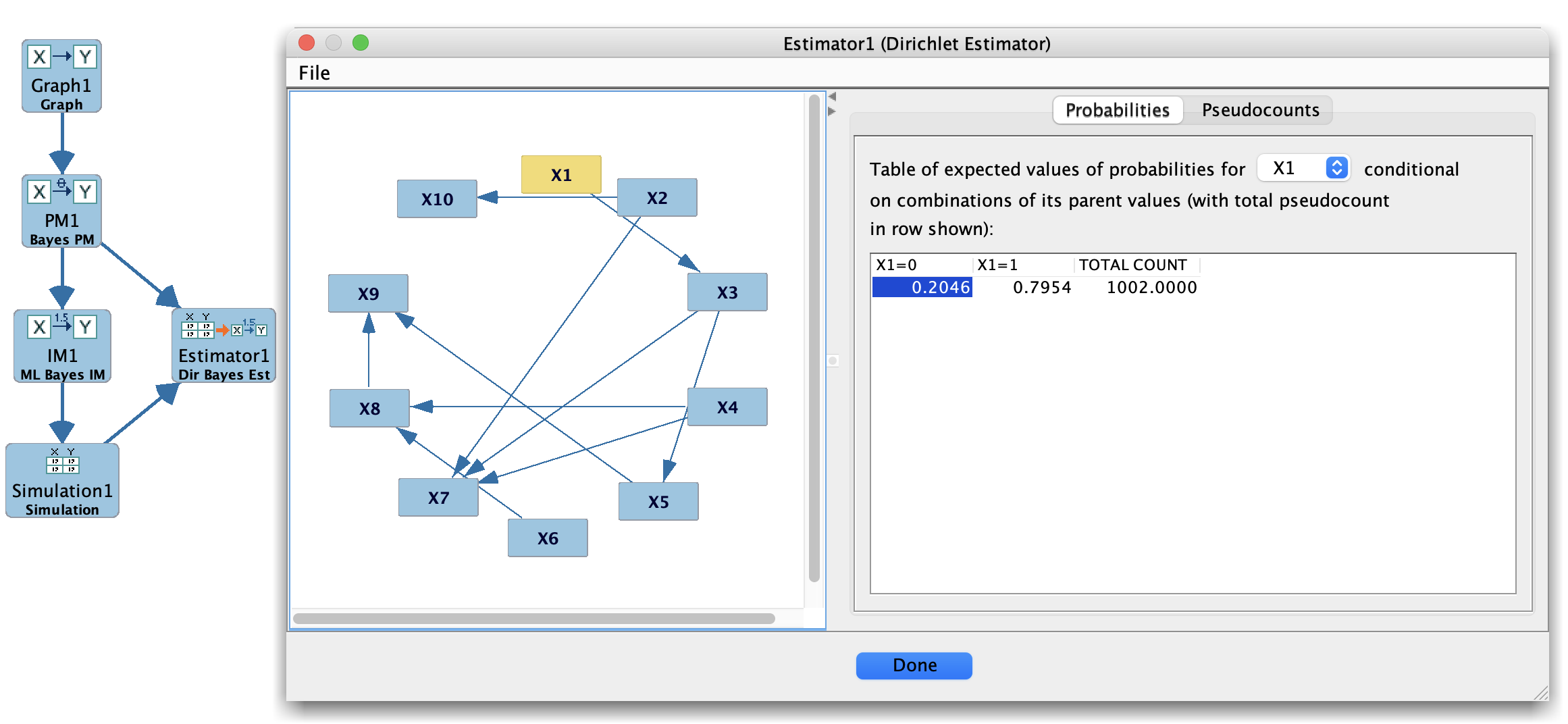
Dirichlet Estimator
Purpose
Estimate CPTs using posterior mean probabilities under a Dirichlet prior.
Provide smoothed probability estimates that avoid zero counts.
Improve stability when sample sizes are modest or some parent configurations are rare or unobserved.
Inputs and requirements
Parametric Model: A Bayes PM specifying nodes, states, and parents.
Data: Discrete data with variables matching the Bayes PM.
Prior settings (when exposed in the GUI):
Often summarized as a strength or equivalent sample size for a uniform Dirichlet prior (e.g., α > 0).
Some versions may allow non-uniform priors.
How it works (conceptually)
For each node X with parents Pa(X), and each parent configuration pi:
Start with a Dirichlet prior written as Dir(alpha_1, …, alpha_k) over the k states of X.
Observe empirical counts n_1, …, n_k from the data.
Compute the posterior Dirichlet Dir(alpha_1 + n_1, …, alpha_k + n_k).
Use the posterior mean as the CPT entries:
P(X = x_i | Pa(X) = pi) = (alpha_i + n_i) / sum_j (alpha_j + n_j).
Output
A fitted Bayes model whose CPT rows are posterior-mean probabilities under the specified Dirichlet prior(s).
Optionally, a summary of:
Log-marginal likelihood or other scores (depending on implementation).
The result can be saved as an Instantiated Model.
Tips and common issues
Larger prior strengths (equivalent sample sizes) lead to heavier smoothing, shrinking probabilities toward the prior.
For very small datasets or models with many parents, Dirichlet smoothing is often preferable to raw ML.
If you are using the model for score-based structure learning, keep in mind that different Dirichlet hyperparameters can significantly affect scores.