Detail: Markov Checker
The Markov Checker tool helps assess whether a given graph is Markov to a data set (or to another graph), i.e., whether the conditional independencies implied by the graph are consistent with what you see in the data.
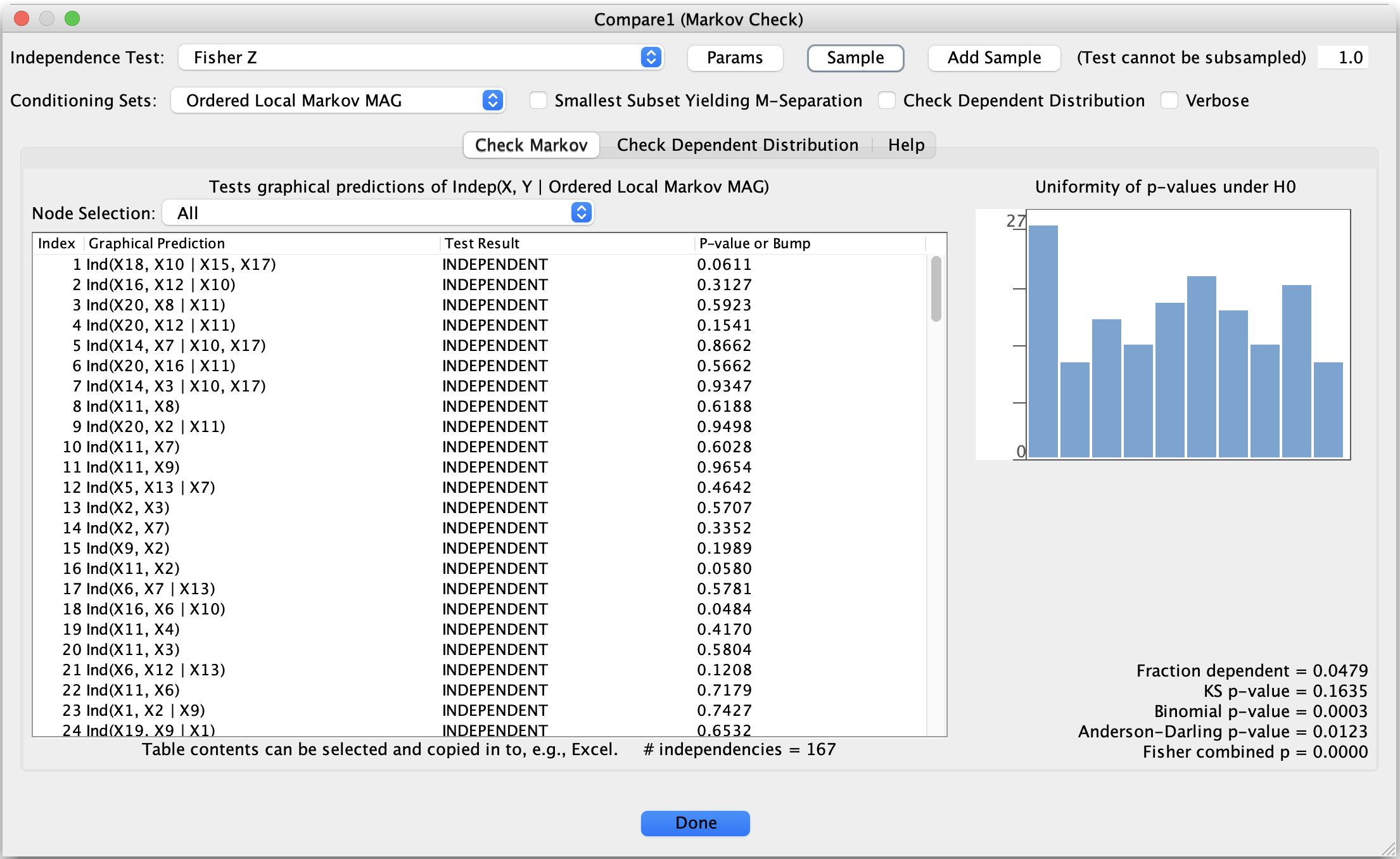
Markov Checker
Purpose
Markov checking is useful when you want to:
Evaluate whether a candidate causal graph is plausible for your data.
Compare graphs learned by different algorithms or under different assumptions.
Diagnose mismatches between model-implied independencies and empirical relationships.
It is especially helpful when:
You have a theoretical or expert-specified graph and want to test it against observational data.
You want to compare a true simulated graph to a graph learned from the same data.
Basic workflow
Open the Markov Checker from the Tools or Graph menu.
Select:
A graph node to test.
A data node on which to evaluate the graph.
A conditional independence test appropriate for the data (e.g., Fisher Z, G-square, kernel CI).
Configure:
A significance level
alpha.Any additional options the test provides (e.g., maximum conditioning set size, kernel basis options).
Run the checker.
The tool will:
Enumerate conditional independencies implied by the graph (or a subset, depending on options).
Test them empirically using the chosen CI test.
Summarize which implied independencies are accepted or rejected at the chosen alpha level.
Outputs
Typical outputs include:
A table listing:
Tested independence statements (e.g., ( X \perp Y \mid S )).
Test statistics, degrees of freedom (if applicable), and p-values.
A flag indicating whether the independence is rejected at the chosen
alpha.
Optional summaries may report:
The fraction of implied independencies that are rejected.
The most strongly violated conditional independencies.
Basic diagnostics or recommendations.
Interpreting results
If few or no implied independencies are rejected, the graph is broadly compatible with the data (at the chosen alpha).
If many implied independencies are rejected, the graph may be:
Misspecified (wrong structure),
Too simple (missing edges or latents),
Or the CI test assumptions may be badly violated.
Markov checking does not prove that a graph is correct; it only checks whether its independence structure is consistent with the data to a first approximation. It is best used alongside discovery algorithms, domain knowledge, and other diagnostics.