Detail: EM Bayes Estimator
The EM Bayes Estimator fits a Bayes Parametric Model using the Expectation–Maximization (EM) algorithm. It is designed to handle situations with missing data and, where supported, latent structure more robustly than plain ML or Dirichlet estimation.
This estimator is available when the Parametric Model is a Bayes PM and the Estimator box offers EM-based options.
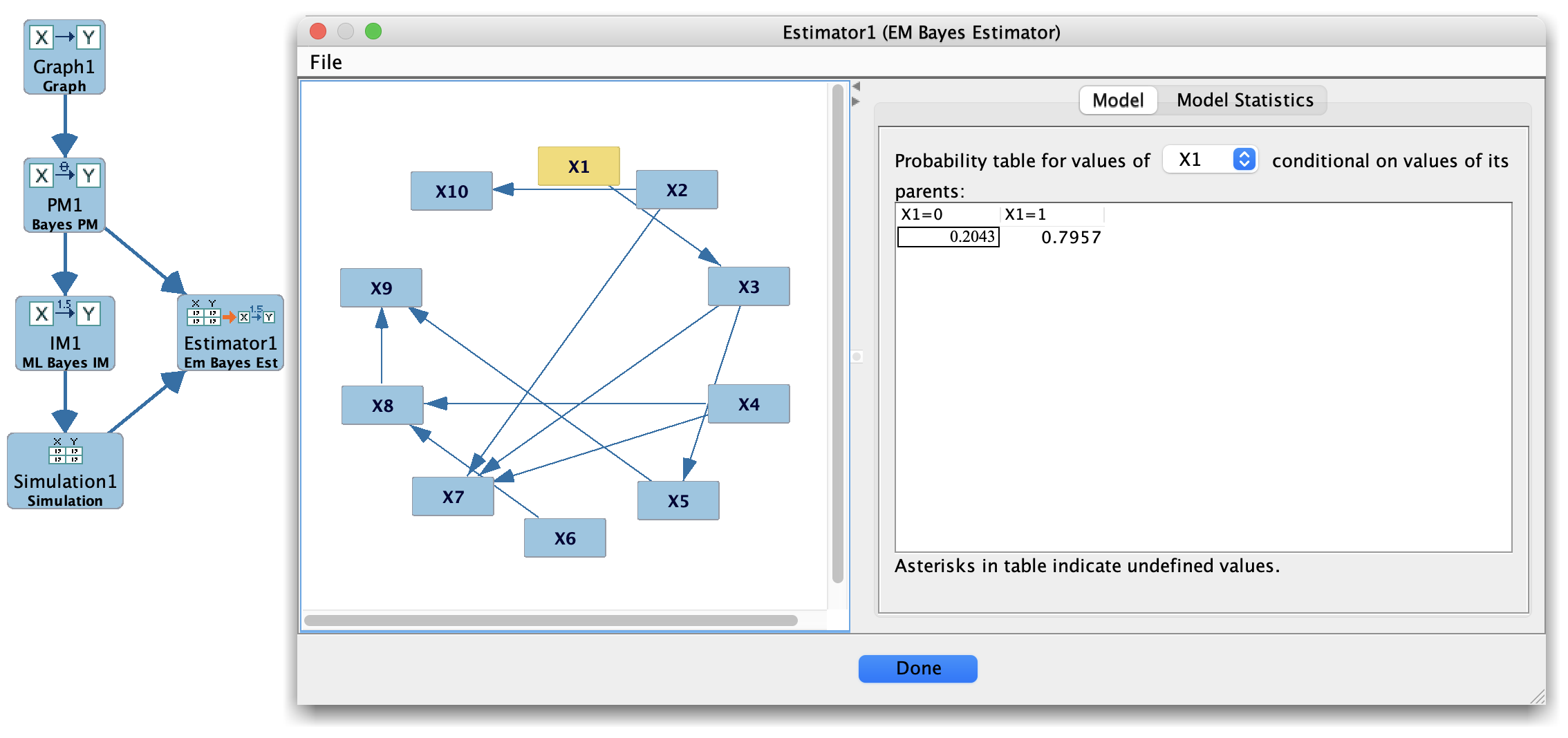
EM Bayes Estimator
Purpose
Estimate CPTs in the presence of missing values.
Provide improved parameter estimates for models with partially observed variables.
Use EM to alternate between:
E-step: computing expected sufficient statistics under current parameters.
M-step: updating parameters to maximize expected complete-data likelihood.
Inputs and requirements
Parametric Model: A Bayes PM.
Data:
May contain missing entries for some variables.
Variable names and states must still be consistent with the Bayes PM.
EM settings (when exposed in the GUI), such as:
Maximum number of iterations.
Convergence tolerance for changes in log-likelihood.
Initialization scheme (e.g., random start or ML/Dirichlet warm start).
How it works (conceptually)
Initialize CPT parameters (e.g., randomly or using ML/Dirichlet).
E-step:
Given current parameters, compute expected counts for each CPT entry, integrating over missing values using the current model.
M-step:
Update CPT entries using the expected counts (e.g., normalized to sum to 1).
Repeat E–M steps until:
Convergence (change in log-likelihood below tolerance), or
Maximum iterations reached.
Output
A fitted Bayes model:
CPT entries reflect EM-based estimates that account for missing data.
Optionally, the final log-likelihood, number of iterations, and convergence status.
Can be saved as an Instantiated Model and used for:
Simulation,
Inference,
or comparison with other estimators.
Tips and common issues
EM can converge to local optima; different initializations may give different solutions.
If EM fails to converge:
Increase the maximum number of iterations.
Relax the convergence tolerance.
Simplify the model or inspect data for severe missingness patterns.
EM may be slower than ML or Dirichlet estimation, especially for larger networks or heavily missing data.