Detail: Approximate Updater
The Approximate Updater performs approximate Bayesian updating for discrete models. It uses sampling-based or approximate inference methods rather than an exact junction tree, which can be useful for larger or more complex models.
It is available when the Updater box is connected to a discrete Instantiated Model or Estimator output, and the updater type is set to Approximate Updater.
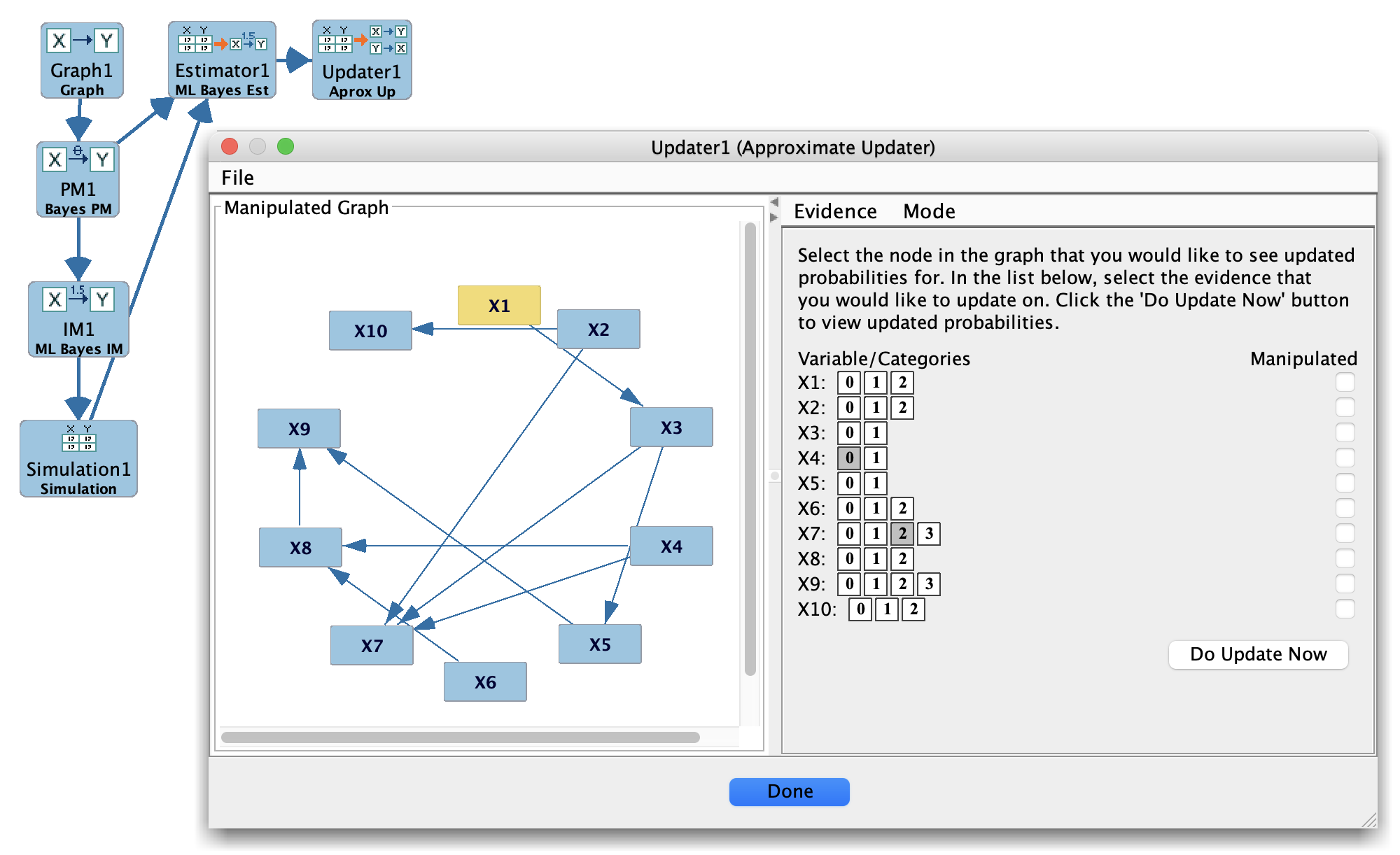
Approximate Updater
Purpose
Provide a faster or more scalable alternative to exact junction-tree updating.
Approximate (P(Y \mid \text{evidence}, \text{manipulations})) when exact inference is expensive or impractical.
Allow exploration of posterior beliefs in large discrete models.
Inputs and setup
Same as the Junction Tree Updater:
Input model: a discrete Bayesian model from an Instantiated Model or Estimator.
User-specified information:
Evidence (variable=value assignments),
Manipulations/interventions (do(X = x)).
Additional approximation settings may be exposed, such as:
Number of samples,
Convergence thresholds,
Random seeds for reproducibility.
How it works (conceptually)
The Approximate Updater typically uses a sampling-based or otherwise approximate method:
Incorporates manipulations by modifying the generative process (e.g., clamping manipulated variables).
Incorporates evidence by:
Rejecting or reweighting samples that contradict evidence (e.g., likelihood weighting, importance sampling),
Or using MCMC methods conditioned on evidence.
Generates a large number of samples from the (approximate) posterior.
Estimates posterior quantities (marginal probabilities, expectations) from these samples.
Because it is approximate:
Results can have Monte Carlo noise,
Success depends on the number of samples and mixing properties of the sampler.
Output
Approximate posterior distributions for variables of interest.
These are typically displayed similarly to the Junction Tree Updater, but with the understanding that they are estimates, not exact values.
Diagnostics (if provided) may include:
Number of samples used,
Basic convergence indicators.
Tips
Use the Approximate Updater for:
Very large discrete models,
Highly connected graphs where the junction tree becomes too large.
Increase the number of samples to improve accuracy, at the cost of runtime.
If exact and approximate updaters are both feasible, you can:
Run both and compare results, to assess the approximation quality.